Susanna Gibson
Explainer
What Is Image‑Based Abuse?
And why we need to stop calling it “revenge porn.”
What image‑based abuse actually is, why consent is central, and how the language we use shapes our response.
By Susanna Gibson
You’ve probably heard the term revenge porn. For years, it’s been the phrase used to describe the nonconsensual sharing of intimate images. It’s familiar, easy to remember, and entirely misleading.
Revenge implies retaliation, as though the person depicted must have done something to provoke it. Pornography suggests consensual sexual material created for an audience. Put the two together, and we’ve managed to describe a form of sexual abuse in a way that directs suspicion toward the person who experienced it. That’s quite an accomplishment, linguistically speaking.
The term also fails to describe much of what actually happens. Image‑based abuse can involve a former partner sharing intimate photographs, a stranger creating sexually explicit deepfakes, someone secretly recording a sexual encounter, or a scammer threatening to expose images unless their demands are met. Sometimes the images are authentic. Sometimes they’re fabricated. Sometimes they’re never distributed at all.
What these experiences have in common is that someone else has made a decision about another person’s sexual autonomy that was never theirs to make.
What Does Image‑Based Abuse Include?
Image‑based abuse is an umbrella term for the nonconsensual creation, alteration, distribution, or threatened distribution of intimate images. The term image‑based sexual abuse was developed by legal scholars Clare McGlynn and Erika Rackley to recognize the sexual nature of these violations.
The most familiar form is the distribution of intimate images without consent. Someone shares a photograph with a partner, believing it will remain between them. Months or years later, it appears on a website, in a group chat, or in an email to their employer. The image may have been created consensually, but the person depicted never agreed to that audience.
Other survivors never knowingly created an intimate image at all. They discover that someone secretly recorded them, captured screenshots during a private video call, or used artificial intelligence to create sexually explicit images from an ordinary photograph. The growing availability of deepfake technology means that someone can experience image‑based abuse without ever having taken or shared an intimate photograph.
Sextortion involves threatening to distribute intimate images unless someone complies with demands for money, additional images, sexual activity, or something else. In abusive relationships, those threats can become a means of coercive control, influencing whether someone feels able to leave, report other abuse, or make decisions about their own life. The images don’t have to be published for the threat to cause serious harm.
These experiences frequently overlap. A person may be secretly recorded, threatened with exposure, and then discover the recording has been distributed to strangers. Real life rarely fits neatly into the categories used by lawmakers, researchers, or reporting systems.
Why Do People Do It?
The stereotype of the bitter ex seeking revenge has shaped public understanding of image‑based abuse for years. Current and former partners are responsible for many incidents, but they’re far from the only people involved. Friends, acquaintances, coworkers, strangers, and organized online communities also create, collect, distribute, and trade intimate images without consent.
A 2025 study by researchers Rebecca Umbach and Nicola Henry surveyed more than 16,000 people across ten countries and found that the most commonly reported motivation for committing image‑based abuse was that the person thought it was funny. Other motivations included impressing friends, gaining social status, and finding the person depicted attractive. Revenge was among the least common motivations reported for sharing intimate images without consent. [1]
That casual attitude helps explain how an image can move from one person to hundreds or thousands of others. Someone forwards it to a friend. The friend shares it in a group chat. Another person uploads it to a website. Each participant may see their own involvement as relatively insignificant, while the person depicted is left dealing with the combined consequences of everyone’s decisions.
The fact that someone didn’t intend to cause harm doesn’t mean they bear no responsibility for creating it. There are important distinctions between reckless behavior and deliberate attempts to humiliate, extort, or terrorize someone, particularly when determining legal consequences. But a person’s claim that they were only joking doesn’t make another person’s consent irrelevant.
Why Consent Is the Most Important Question
One of the first questions survivors are asked is often some variation of Why did you take that picture? It’s a question that sounds reasonable until you consider what it’s actually asking.
People share intimate images for all kinds of ordinary reasons. They flirt, maintain relationships across distance, explore their sexuality, and share moments of intimacy with people they trust. Most of the time, that trust is respected. When it isn’t, we have an unfortunate tendency to question the judgment of the person who trusted someone rather than the conduct of the person who betrayed that trust.
We understand this distinction perfectly well in other contexts. If you share financial information with a spouse and they drain your bank account, we recognize the wrongdoing. If you disclose medical information to a health care professional and they publish it online, we don’t spend much time debating whether you should have trusted them in the first place. Yet when the information involves someone’s sexuality, that clarity has a remarkable way of disappearing.
Consent to creating an intimate image is specific to that act. It doesn’t authorize recording, copying, distributing, selling, or publicly displaying the image. And when someone creates a sexually explicit deepfake, the person depicted may never have consented to anything at all.
Why the Language Matters
Image‑based abuse is often discussed as a privacy violation or a reputational problem. Privacy is certainly implicated, and the consequences for someone’s reputation can be devastating. But those descriptions don’t fully account for the violation of sexual autonomy at the center of the experience.
Survivors can face anxiety, depression, threats, harassment, damaged relationships, and lost employment opportunities. Some spend years trying to remove images from websites and private networks, never knowing when another copy might appear. Others find that the institutions they turn to for help are more concerned with the existence of the images than with how they came to exist or who distributed them.
The language we use influences those responses. It shapes whether employers, schools, law enforcement, and the public recognize someone as a person experiencing sexual abuse or treat them as someone who has created an embarrassing situation for themselves.
That’s why I use the term image‑based abuse. It describes a much broader range of conduct, places responsibility where it belongs, and recognizes the central role of consent.
We have spent far too long asking why people took intimate photographs, why they trusted someone, or why they didn’t anticipate what might happen. Instead we should start asking why so many people believe they’re entitled to make decisions about someone else’s body, and what we’re going to do about it.
Source
[1] Rebecca Umbach and Nicola Henry, “Perpetration of image‑based sexual abuse in the digital age: prevalence, motivations, and community attitudes in 10 countries,” Journal of Cybersecurity (2025). https://doi.org/10.1093/cybsec/tyaf033
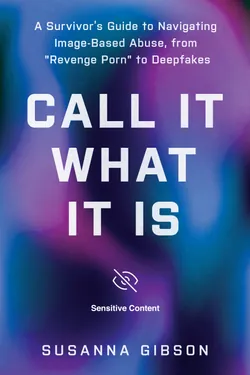
Adapted from Chapters 1 and 3 of Call It What It Is: A Survivor’s Guide to Navigating Image‑Based Abuse, from “Revenge Porn” to Deepfakes by Susanna Gibson, forthcoming from BenBella Books, March 30, 2027.
Further reading: Terminology & Glossary · Survivor support resources · Explore the book
Out March 30, 2027
Call It What It Is
A Survivor’s Guide to Navigating Image‑Based Abuse, from “Revenge Porn” to Deepfakes
Need help with image‑based abuse? Start here.